To most passers-by the Adam Smiddy Park on the corner of Park Road and Gordon St in Milton is a small grassy area with some benches to eat lunch, however the significance of the name leaves a strong legacy of Adam Smiddy’s fight against cancer.
Adam Smiddy was a talented triathlete and respected physiotherapist, but his life was cut short in 2006 when he passed away at just 26 years old from an aggressive melanoma. Despite his battle with cancer, Adam never lost his disarming smile and kind-hearted nature. His death left a profound impact on his family and friends.
Six weeks after Adam died, his friend and triathlon coach, Mark ‘Sharky’ Smoothy, along with two other mates, fulfilled one of Adam’s unrealised dreams by cycling 1,600 kilometres from Brisbane to Adam’s hometown of Home Hill. They had nothing but a credit card in their back pockets and in the process, raised an incredible $24,000 for cancer research.
This journey was just the beginning of something bigger. In the following year, 22 friends joined Sharky, Ron Steel, and Oliver Bodak for the ride, and in 2008, the group had grown to 50 riders, who raised an astounding $420,000 for cancer research. The Smiling for Smiddy Foundation was born.
Since then, the Smiling for Smiddy legacy has continued to grow, with more and more people joining the fight against cancer. The foundation has raised over $10 million for world-class cancer research at Mater in the areas of melanoma, prostate, breast, and ovarian cancers. The Smiling for Smiddy Foundation is proof that every contribution counts, no matter how small it may seem.
His legacy also lives on through the Smiddy Fun Run, an event organized by the Physiotherapy Department of the Princess Alexandria Hospital (PA) to celebrate and remember Adam through something he loved doing. The run takes place every year to help raise funds and awareness for skin cancer research at the PA, and has raised over $150,000 to date.
Adam may have left this world too soon but his legacy and the fight against cancer continue. The Adam Smiddy Park is a stark reminder of his valuable work.
The Tattoo is set to return to Australia for the first time since 2019, with two shows scheduled in Milton to commemorate its 75-year milestone. The international event, known for showcasing military bands, bagpipers, and dancers, began in Edinburgh as a tribute to Scottish and British tradition. Over the decades, it has evolved into a global stadium production featuring over 1,000 performers from more than 50 countries.
Suncorp Stadium in Milton has been selected as the sole Australian venue for the 2026 Tattoo tour. The two performances, scheduled for 12 and 14 February, will be themed “The Heroes Who Made Us”
Organisers aim to reach a global audience exceeding 100 million viewers. The announcement marks the Tattoo’s first return to Australia in seven years and positions Brisbane as the exclusive host for the anniversary edition.
Photo Credit: RACQ
Event Draws Support from Government and Industry
Queensland officials supported the bid to bring the Tattoo to Brisbane, citing expected economic and reputational gains. Projections suggest the event could generate up to $39 million in economic benefits for the state. Organisers noted Brisbane’s selection was influenced by Queensland’s preparations for the 2032 Olympic and Paralympic Games, highlighting the region’s rising global profile.
RACQ Partners as Event Sponsor
The 2026 edition will be presented by RACQ, which has aligned its sponsorship with values of heritage and community celebration. RACQ confirmed it will offer exclusive member benefits, including ticket discounts and travel packages. These offers will be managed through RACQ Travel and promoted directly to members in the lead-up to the event.
Photo Credit: RACQ
Performers and Cultural Significance
Pipe Major Alisdair McLaren, a Perth native, is among the performers, having directed previous Tattoo appearances since 2017. He has also trained Australian pipers, including representatives from Brisbane Boys’ College, to participate in past editions of the show. The Tattoo remains the largest international platform for bagpipers and military musical ensembles.
Tickets for the Milton shows will be available from 21 May 2025. Additional details, including RACQ member offers and package deals, will be released in the coming days via official channels.
Game 1 at Lang Park, refereed by the Grasshopper, had been secured by the Maroons 24-12, with The King crossing over for 2 tries and Mark Murray getting another to the Blues 2 tries (by Steve Ella and Eric Grothe).
The game has gone down in folklore however as it was the one that Les Boyd broke the “Big Marn” Darryl Brohman’s jaw with his elbow.
The grasshopper didn’t send Boyd off and the Big Marn, who had been widely expected to be picked for Australia three days later lost his opportunity that turned out to be his best.
Boyd was not even cited by the NSWRL, and in fact was due to play in that game for Australia against New Zealand until Charlie Gibson, the secretary of Penrith where Brohman played his club football, cited him, eventually leading to a 12 month ban.
Boyd also got involved in an exchange of punches with Paul Vautin, which threatened to turn the pitch into mayhem until Dave Brown, the Maroons front-rower, landed one on the chin of Boyd, which calmed everything down.
Game 2 1983
Game 2 appeared to be a great opportunity for the Maroons to shut the gate on the series, with several NSW players out due to injury. (Unlike today, the players had to play for their clubs between Origin fixtures). Virtually the whole Blues backline was taken up by players from “reigning premiers”, the Parramatta Eels.
In fact, the Eels provided eight of the Blues starting line-up, which remains a record for an Origin game.
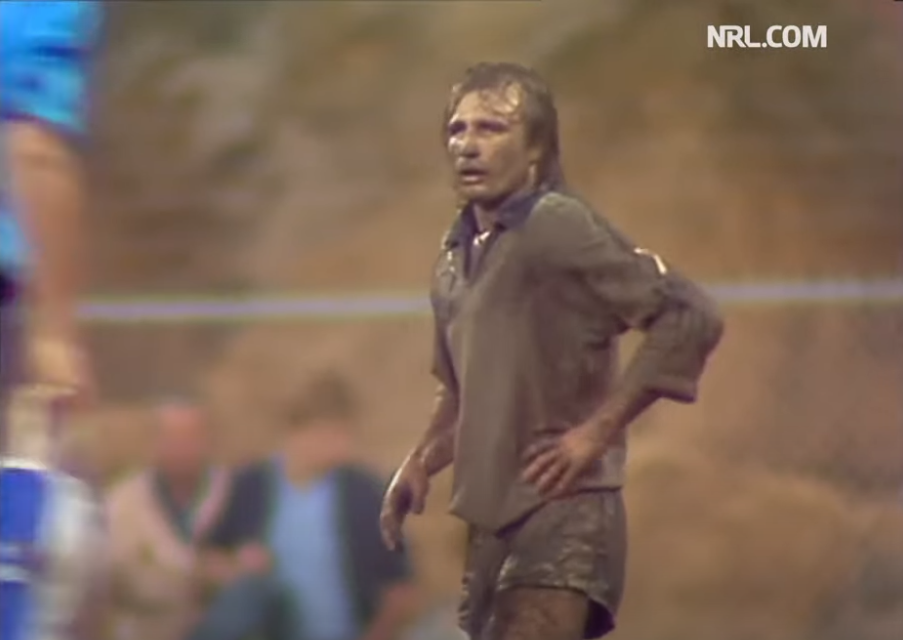
The game was played on a very muddy Sydney Cricket Ground in front of 21,620.
Mal Meninga opened the scoring and converted his own try, matched by a Blues try from Neil Hunt, converted by Mick Cronin.
A great kickthrough by Marty Gurr on a quagmire left Steve Ella with what ended up being the match-winning try.
However, the King appeared to have gone over under the posts midway through the second half, which with the conversion would have put the Maroons in front but the ref blew up for a shepherd by Gene Miles and the Blues held on 10-6 to take the 1983 series into a decider at Lang Park for the first time.
Peter Sterling was named game 2, Man of the Match.
Photo Credit: NRL
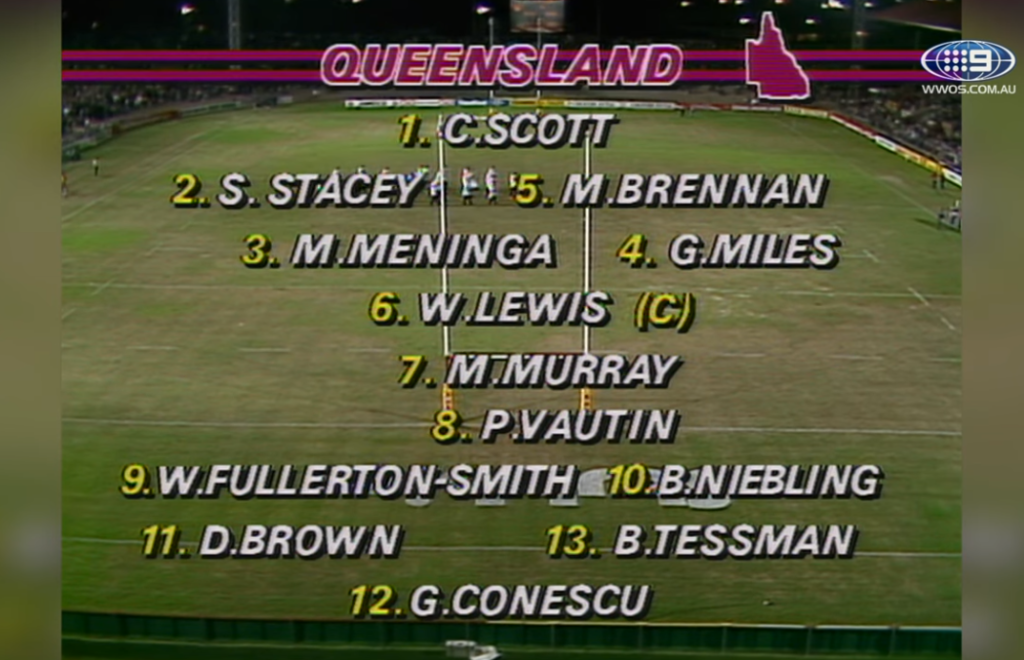
The Maroons line-up for game 3 (Note: Brad Tessmann’s name has 2 n’s)
Photo Credit: WWOS.com.au
Game 3 1983
So it came to game 3.
Peter Sterling was injured, being replaced by Steve Mortimer, a pivotal moment in their careers as Mortimer went onto maintain the spot for the next 2 years for the Blues and for Australia.
It didn’t take long for Mark Murray to break through tackles to set up Greg Conescu for the first try.
Then Mel Meninga was the beneficiary of a beautiful chip kick from The King, only to be denied by an extraordinary tackle forcing Meninga to knock the ball on over the line.
Steve Stacey went over in the right hand side corner for the Maroons second try.
Brad Tessmann’s fantastic offload to South Sydney’s flying machine Mitch Brennan led to the third Maroon’s try under the black dot.
“The King” put the tin lid on the first half with a drop goal to send the Maroons in at half time, 21-0 up.
The opening try of the second half came as Mel Meninga stepped off his right foot, drew his man and laid an inch perfect pass for Mitch Brennan to cross for his 2nd try of the game.
Not long after, “The King” setup Mark Murray to break the line and send a dodgy pass to Bryan Niebling who put himself on the scoresheet, taking the pass on the half-volley in stride to touch down.
Having been completely mauled to death, the Blues found some ticker and threw the ball around, Chris Anderson going over for the first Blues try, well into the 2nd half.
However the Maroons were not finished, big Dave Brown powering over after Steve Stacey had set the defence on the back foot.
Steve Mortimer then scored a soft try after a high bomb from Kevin Hastings was lost under pressure by Colin Scott followed by another from the Blues winger, Chris Anderson, that made it 37-18 to the Maroons.
Steve Stacey couldn’t grab the bobbling ball from a kick through after a Blues full length counter-attack finished with Chris Anderson’s hat-trick 3rd try.
The King wanted more tries in the dying minutes and so opted to take a tap penalty which opened up an exhausted Blues defence, enabling Gene Miles to score the final try of the series.
And there it was Queensland’s first ever State of Origin Lang Park Decider Victory.
Another masterclass from “The King’ led to a second Man of the Match title in the 1983 series for Walter James Lewis.
As Steve Haddan reported in his fantastic BRL History tome, 1983 saw Bob Hawke as Australian PM, Alan Bond in the America’s Cup and the BRL had a dip in crowds, though a try became worth 4 points instead of the previous three. Tommy Raudonikis was sent off in Round 2 for Brothers in his swansong season, then knocked out in Round 8.
Redcliffe went on to win the 1983 BRL minor premiership with their 38-10 win against Souths at Dolphin Oval, Easts blew their opportunity by losing to Wynnum-Manly 38-10 at Kougari Oval.
At the end of the 1983 season, young Coach Wayne Bennett was Coaching Director at Souths Juniors but was given an opportunity to take the head coach role at Souths and resurrect his coaching career, when Bob McCarthy decided to stand down after four years at Davies Park.
When Bob McCarthy’s Magpies went down to Valleys 30-22 in the minor semi final(3rd vs winner of 4th vs 5th) at Lang Park, McCarthy exclaimed “Wally Lewis is the closest thing i have seen to Bob Fulton and I’ve been around since 1954.”
In the Major BRL Semi-Final(1st v 2nd) of 1983, Easts beat Minor Premiers, Redcliffe, 11-5, including a field goal for Trevor Paterson, being his first since playing for the under 11s in Toowoomba.
The preliminary Final was won easily by Redcliffe over Valleys, 28-10, Valleys coach Ross Strudwick blaming the ref’s penalty count of 10-3 in favour of Redcliffe in the first half.
This was the last game Wally Lewis played for Valleys, after president Tom Dooley told him they could no longer afford him, reluctantly Lewis went to Wynnum-Manly.
The Rothmans Medal of 1983 was awarded to Trevor Paterson of Easts, a 20 year old, unemployed Boilermaker, just pipping Gene Miles by 1 point.
Some 25,000 spectators turned up for the 1983 Grand Final on 18 September at Lang Park, it had been 36,000 in 1982. The decider was won by Easts 14-6 with Rothmans Medalist, Paterson, man of the match, though he credited half-back Wayne Lindenberg (who heavily influenced Easts’ premiership title wins in 1977 and 1978) with the main reason Easts got up.
At the 67-minute mark, when only 2 points up, Lindenberg sliced through the tired Redcliffe defence twice to set Brett Tengdahl off on a 70-metre run to the line and then put Brad Backer away down the wing, a few minutes later. For Easts’ Coach John Lang, the title would be upgraded 20 years later when winning an NRL Premiershp with the Penrith Panthers.
A Golden year for the BRL even if the crowds were down.
EASTS WINNING SIDE:
G.Payne
M.McDonald
B.Tengdahl
R.Kelly
B.Backer
W.Lindenberg
L.Briggenshaw (captain)
B.Le Man
T. Paterson
G.Jones
S.McNally
M.Sahl
C.Heugh
L.Bogle(Reserve)
J.Lang(Coach)
The Maroons Legends Who Took The Field In the 1983 State Of Origin Series:
Colin Scott played Full Back for all 3 games.
Born in Charters Towers.
Played Junior and Senior footy for Souths in Townsville with Gene Miles.
Played for Easts Tigers in Coorparoo in 1980 (he was put in the reserves yet was still selected for the Qld team) and then Wynnum-Manly Seagulls from 1981-1987.
Played for Castleford in UK 1985-1987 in the off-season.
Played in the interstate series before Origin began, then played Origin until 1987 when Gary Belcher took his spot.
Played for the Broncos in their inaugural season in 1988 in the NSWRL Premiership.
Scott is FOG #2 because he stood aside for Arthur Beetson who was made FOG #1
First Maroons Origin Full-Back, part of the Wynnum-Manly premierhsip winning teams in 1982 and 1986.
Missed the 1984 Origin Decider after getting his first-ever suspension.
“I was the number one in the very first Origin. I was the number one for the Broncos when they first started. I was the number one for Wynnum Manly when they won their first ever A grade grand final.”
“I remember when we went in the dressing rooms at Lang Park and I was getting changed. Arthur walked over and said ‘how are you going Scotty?’ and I couldn’t believe it.”
“I went down to the phone box after the game, rang my mum and told her that Arthur Beetson knew my name.”
The QRL wrote a great article about Colin which you can find here
John Ribot played Wing for Game 1.
Born in Brisbane as John Ribot de Bresac but known as John Ribot.
He played club footy for Valleys, Wests, and Redcliffe; then in Sydney for the Newtown Jets, Western Suburbs Magpies, and Manly-Waringah Sea Eagles
In 1980, Roy Masters (coaching the Magpies at the time) moved Ribot from Lock to the Wing
His international career included being part of the 1982 Invincibles touring squad and scoring 4 tries for Australia against PNG in Port Moresby in 1982
Ribot represented NSW in 1978 based on th residential rules of the time.
On retirement Ribot became the QRL Development Manager and the original CEO for the Broncos in 1988.
He challenged the NSW stranglehold on footy and ran a campaign to hold the NSWRL Final in Brisbane at the ANZ Stadium (QE II Stadium) which had a 60,000 capacity at the time.
Ribot’s post playing career included being CEO of the Super League and helping facilitate a peace deal with the ARL, as well as being Chairman of the Queensland Roar FC and on the board of the TAB Qld. A great summary of his playing career here as well as the teammates he played with.
Terry Butler played on the wing for Game 2.
Born in Kyogle, NSW
Played Junior Football for Souths in Townsville with Gene Miles.
Played for Wynnum-Manly Seagulls in the BRL, where he scored the first try in the 1982 Grand Final.
Played against Steve Stacey regularly (Eastern Suburbs) in the BRL.
Sadly passed away in 2016, from cancer at only 58, in Townsville.
Mal Meninga played Centre for all 3 games.
Born in Bundaberg.
Played club footy for Southern Suburbs Magpies (1979-1985); then for St Helens in the UK 1984-1985; and finished his career with 9 seasons at the Canberra Raiders until 1994.
Was a serving police officer with the QPS until 1985, where he first met Wayne Bennett.
When he retired from the game he held the record of most Australian appearances and the top points scorer in Origin history.
He is the only player to be selected for 4 Kangaroo Tours, in which he played in every test match in all four tours.
As a goal-kicking swashbuckling centre, he was one of the last toe-pokers, he kicked 181 goals for Australia and 69 for the Maroons in Origin (as well as 9 in the Interstate series).
He captained the Kangaroos for 23 test matches and the Maroons for 3 Origin series(the Maroons lost all 3).
As coach of the Maroons he presided over the greatest Origin streak with 9 wins between 2006 and 2015. When he took over in 2006, the Blues had won the three previous Origin series, Meninga’s teams would win 8 straight, with his only lost series being 2014. See Mal’s NRL Hall of Fame entry here and a doco on the big man here.
Gene Miles played all 3 games.
Born in Townsville.
Played junior club footy at Souths in Townsville then seniors at Wynnum-Manly from 1980 to 1987 before joining the Broncos in their inaugural season in 1988 until 1991 and finishing his career at Wigan in the UK in 1991 and 1992. (The BBC did a great series inside the club which featured Gene. Footy fans will love it — you can see an episode here.
He played 14 times for Australia between 1982 and 1988 including with The Invincibles in 1982.
He started his career at Centre but switched to playing in the second-row at the Broncos.
Great podcast put together by the FOGS team with Gene here and a Face-to-Face here
Steve Stacey played on the wing for Games 1 and 3.
Played his junior club football for East Carina Juniors then made his first grade debut for Eastern Suburbs at the age of 17.
Played 262 games for Eastern Suburbs, 6 games for Brothers and 16 games for Salford in England
With Eastern Suburbs, he played alongside John Lang in the 1977 BRL Premiership winning team then under Lang as coach when Eastern Suburbs won the BRL Premiership again in 1983.
Chris “Choppy” Close played on the Wing for Game 2.
Born in Cunnamulla.
Played Junior footy for the Wondai Wolves and made A-Grade debut for the Beaudesert Kingfishers then joined the Valleys in 1979; Redcliffe in 1980-81; Manly-Warringah in 1982-87; and then joined the newly formed Gold Coast Chargers in 1988 until 1991, as well as a stint with Hull KR in 1988-89.
He played in his first Interstate game at the age of 20 and played four further games, including the famous back handed slap on Eric Grothe to clear him out of the ruck, enabling Close to dive over from dummy-half to secure the Interstate win in 1981.
He then represented the Maroons 9 times in Origin.
He became Maroons Team manager in 1995.
Choppy was not very impressed with Gus Gould challenging the Maroons spirit in 2005 and so when Matt Bowen went over for the match-winning try of Origin 1, he stuck the middle finger up from the bench, directly at Gould. “It really did have a lasting legacy because I think I was acting on behalf of every other Queenslander at that moment in my life and when I shot that finger up to New South Wales and particularly to Gus Gould – I think everyone could resonate with that,” he said on the Pat & Heals show on SEN.
Mitch Brennan played on the Wing for Game 3.
Born in Brisbane.
Before his footy career took off in Australia, Brennan trialed and was offered a contract with the Totonto Argonauts in the Canadian Football League, but visa problems brought him home.
He played his junior footy in varous places including Charleville and West End then made his NSWRL debut on a pre-season trial match for St George under the pseudonym of “Mickey Lane” because he was in contract negotiations with Souths in West End. He was rumbled and fined $500; did sign for Souths Magpies but also ended up playing for St George in 1978-80; then South Sydney 1981-82; then Redcliffe 1983-85; then finished hs career at the Canberra Raiders 1986-88.
He played 4 Origin games and scored 3 tries in those 4 games.
Scored a hat trick of tries in the final game of the 1983 Season, to help Redcliffe claim the minor premiership.
The King, Wally Lewis played at Five-Eighth and captained the side for all 3 games.
Born in Hawthorne. His dad Jimmy was playing First grade for Wests and Souths; his mum June represented Queensland at Netball. Not a bad pedigree!
Wally started playing in the Cannon Hill Stars. At six years old, he started in the under 8s and played there for five years; then moved to Valleys as a junior whch led to him playing for the senior team from 1978 in the BRL. He went to Brisbane State High School.
Wally represented the Australian Schoolboys Rugby Union team alongside Mark Ella, Glen Ella and Gary Ella as well as Michael O’Connor and Tony Melrose. The QRU ordained that Wally would not be picked for future rep teams if he continued to play League as well, which focused him on playing League in the BRL with Valleys.
Wally’s Queensland debut (under State of Residence) in 1979 was followed by his Origin debut in 1980, which was controversial as the pundits felt Norm Carr of Wests was a better option. This was soon forgotten as Wally set up Kerry Boustead to score the Maroon’s very first Origin try, the first of a boat-load of Origin assists over the next eight years.
Whlst playing for Valleys at lock alongside Ross Strudwick against Norths that included Mark Murray, Lewis was spark out after a ball and all tackle on Mark Graham. Dr Tom Dooley (Valleys) and Dr Keith Woodhead (Norths) ran onto the field and mouth-to-mouth had to be administered to the King. Dr Dooley diagnosed a laryngeal spasm at the time.
His 31 Origin appearances only yielded 7 tries, a goal and 2 field goals but the statisticians will have lost count with how many tries he created for others, especially with the long cut-out pass that he developed in his union days and honed in his backyard with his brothers, Heath and Scott. His Origin record was 19 wins and 12 losses.
He represented Australia 35 times, scoring 12 tries, clocking up 30 wins and 5 losses. Today Tonight ran a feature on The King when he was only 23 and 60 minutes also here. In Brisbane there will only ever be one King!
Mark Murray played halfback for all 3 games.
Born in Brisbane.
Originally based in the Darling Downs, Murray played junior footy at the Millmerran Rams.
In 1978 he came to Brisbane to attend Teachers College and was about to sign for Wynnum-Manly when Norths president Bob Bax offered him more money. After three years at Norths Devils, including a premiership win in 1980 under Graham Lowe, he played the 1982 season for Valleys with the King and then from 1983-86 at Redcliffe.
He played 7 times for Australia and 15 times for the Maroons.
He sustained an eye injury which forced early retirement and the start of a coaching career at the age of 29.
Brad Tessmann played Prop for all 3 games.
Born in Kingaroy.
He captained the Queensland Under 18 team in 1978.
Tessmann played junior footy at the Kinagroy Redants and then moved into the first grade team at the age of 17. He joined Sourthern Suburbs in the BRL from 1980 to 1983; then Redcliffe in 1984; Eastern Suburbs from 1985 to 1987; and then signed for the inaugural season of the Broncos in 1988
1983 saw Tessmann get a call up to the Australian side to play New Zealand at Lang Park but the night before he got food poisoning and was constantly throwing up. Luckily, Coach Arthur Beetson stayed patient and he ended up playing for most of the game.
Greg Conescu played Hooker for all 3 games.
Born in Brisbane to Romanian parents.
Played junior footy for Norths St Josephs and made his First Grade debut in 1979 for Norths, playing in their Premiership winning team in 1980. He stayed at Norths until 1983 then went to Redcliffe from 1985 to 1987, joining the Broncos for their inaugural season in 1988.
Wayne Bennett controversially dropped Conescu in favour of Kerrod Walters despite Conescu being in the Australian side.
He played 20 Origin games and 9 times for his country.
Darryl Brohman played Prop for Game 1.
Born in Brisbane.
Played junior footy at Norths but while still at Wavell State High School he made his first grade debut.
He joined the Penrith Panthers in 1979 and played 71 games for them, including as captain for 2 seasons until signing for the Canterbury Bulldogs 1984-85 before returning to the Panthers for 1986-87.
As well as the infamous Origin Game 1 in 1983, where Les Boyd’s shocking elbow broke his jaw, the Big Marn also represented the Maroons in Game 2 of the 1986 series and this time attracted a shocking knee to the face by Steve “Blocker” Roach. Unlike the Grasshopper not punishing Boyd’s elbow, Blocker did go to the bin for his transgression.
Dave Brown was interchange for Game 1 and played prop for Games 2 and 3.
Born in Brisbane.
Played his junior footy with Kingaroy then joined Souths at 19 years old in 1978. He was the Souths enforcer for the 1979 BRL Grand final but went down 26-0 to Valleys. See the full game here. Then, he played for Souths in the 1980 grand final, going down to Norths. (See the full game here, though resolution is not great.) He then played for the Eastern Suburbs (1981-82); Manly Sea Eagles (1983-84); and back to Eastern Suburbs (1985-86). That was his journey before cashing in and playing for Hull FC in the UK.
He finished his career at Redcliffe, where he continued the trend of losing in the grand final, this time to Brothers in 1987.
Brown’s 10 Origin appearances and 5 for Australia culminated in 1 try in the Origin decider in 1983; though it’s best not to check the replay as even Big Dave thinks he got away with one there and credits The King for telling the ref it was a try — so what else could the ref do but award it?
Bryan Niebling played second row for all 3 games.
Born in Murgon.
Got the nickname “Horse” when he was boarding at Tommy Duggan’s mother-in-law’s house at Chermside. His landlady told Tommy that Bryan ate like a horse; so Tommy being the king of nicknames called him “Horse” and it stuck.
Played Junior Footy at Murgon (population 3,000 but produced Brian and “The Pearl” Steve Renouf), then joined Valleys in 1980; then Redcliffe in 1984; and signed for the Broncos in their inaugural season in 1988, before performing the tradition of a payday swansong at Hull KR in the UK.
He was best man at the King’s wedding and the King was best man at Bryan’s wedding.
He played 9 Origin games for the Maroons and 13 games for Australia
Paul “Fatty” Vautin played second row for Game 1 and Lock for Games 2 and 3.
Born in Brisbane.
Played junior footy at Wests Mitchelton; went to the Origin Factory at Padua College in Kedron; then played for Wests in 1978. He was coaxed out of Brisbane to Manly-Warringah, where he stayed for a decade, before going to St Helens in 1988-89 and then coming back to Sydney’s Eastern Suburbs.
He had 22 appearances for the Maroons, crossing for 2 tries and 13 appearances for Australia.
He coached a young Maroons side that were very much underdogs to a 3-0 Origin series win in 1995; but then led his team to a 3-0 series defeat in 1996 when conidered favourites.
In 1988, Fatty got his first commentary gig, alongside David “Thirsty” Morrow on the ABC. In true Fatty fashion, he dropped an F-bomb thinking he was not going out live, when it turned out he was. Despite this, his broadcasting career took off 6 years later.
The Footy Show with the Fat man at the helm was priceless, here are some highlights: Part 1 Part 2 Part 3 and here are some Dare Devil Dudes.
Wally Fullerton-Smith played lock for Game 1 and second row for Games 2 and 3.
Born in Roma.
He played his junior footy with Cities at Roma and made his First Grade debut for Redcliffe at the age of 19, having only started playing when he was 16 in 1980. He stayed with the Dolphins until 1986 but also played for Tonneins in the French Division 1, as well as for Leeds in 1984-85, before finishing his Australian career at the St George Dragons between 1987 and 1992, with a final season in the French league at Cannes in 1992/93.
He had 12 appearances for the Maroons and 8 for Australia.
He started his senior career with Wynnum-Manly, where he scored the match winning try to win the BRL Premiership in 1982(team included Colin Scott, Gene Miles, Greg Dowling, Mark Zillman and Terry Butler). He then went to St Helens in 1985; then came back to play for the North Sydney Bears the following year until 1989; and then finished his career at the Gold Coast Seagulls in 1990/91
He started in 5 Origin matches, 2 in 1984 and all 3 in 1988.
Brett’s brother also played for the Maroons (all 3 games in 1985,’86 and ’87).
Bruce Astill was interchange for Game 3.
Born in Brisbane
He played his junior footy for Souths Acacia Ridge and Played A Grade for Souths Magpies at the age of 19 in 1974 and went on to captain Souths to their Premiership win in 1981
In 1982 he had quite a roller-coaster as this video shows. The BRL Dally M Awards lasted only 2 seasons but long enough for Anstill to be awarded Superstar of the Year award; however, the award was received a few days after he had been banned from playing in the Grand Final for what was considered a kick towards the King who didn’t flinch.
He was on the bench in 1980 and interchange in Game 3 of the 1983 series.
Ross Henrick was interchange for Game 2.
Born in Brisbane and sadly passed away in 2005 at the age of 50.
Nicknamed the angry due to his size and competitiveness.
He played his junior footy for Norths and then into the seniors then he went to Redcliffe where he played for 4 seasons until he returned to Norths(1979-1982) and was in the team that won the BRL Premiership in 1980. The his final stop was at Valleys from 1983 to 1985, a good interview with him whilst skipper at Valleys here.
Henrick played 3 Origin games for the Maroons.
Henrick coached Valleys to win 3 BRL Premierships and later coached Wavell State High School’s Rugby League team.
Gavin Jones was interchange for Game 3.
Born in Brisbane.
Jones played Junior footy for Souths Woodridge; then played for Easts when he was selected for the 1983 Origin game as an interchange. Hr had a season at Leeds in 1984/85 and signed for North Sydney in 1986, where he had a great debut season which led to him playing all 3 Origin games in ’86 but he broke his arm in the end of season playoffs ruling him out of a Kangaroos tour.
He had a total knee construction in 1987, forcing him to miss the season. However, he came back from the surgery in great form, only to then be injured again in 1991. He made it back for the finals, where North Sydney only just failed to reach their first grand final for 48 years. He spent his final season at Cronulla-Sutherland in 1996.
A significant development application has been lodged that could see a retirement village featuring 76 independent living units established within the grounds of the historically significant St Francis Theological College in Milton.
The proposal by Aura Holdings outlines plans for three new residential buildings on the expansive 3.83-hectare site, which currently serves as a religious and educational campus.
The submitted plans detail the retention of several heritage-listed buildings on the site, most notably the Old Bishopsbourne residence, dating back to 1868, and the Chapel of the Holy Spirit, built in 1912. The new buildings, ranging from four to six storeys, have been designed to minimise their visual impact on these historical structures and to preserve important sight lines across the property.
The proposed living spaces will include a mix of two- and three-bedroom apartments, some featuring additional multipurpose rooms. Residents can access various communal facilities, such as a gymnasium, library, swimming pool, barbeque area, rooftop terraces, and a firepit lounge. Furthermore, shared function rooms are intended to be available for use by both the future residents and the existing parish and college community.
Landscape design is a key component of the proposal, with over 13,000 square metres dedicated to deep planting and landscaping on podiums and rooftops. The plans also include provisions for 95 car parking spaces, with access to be maintained via the current internal road network.
The application did not specify the number of bicycle parking spaces included in the design. Cox Architecture is responsible for the architectural design, with Urbis handling the planning aspects and JFP Urban Consultants overseeing the landscape design. The overall design strategy aims to seamlessly integrate the new buildings with the site’s existing natural landscape and historical context.
The arrangement of the three new buildings around a central landscaped common, along with varied building heights and forms, is intended to reduce the development’s perceived size. The design also takes advantage of the land’s natural slope to conceal basement parking.
Setbacks and carefully considered building alignments aim to preserve mature trees, protect important views, and maintain a respectful distance from the nearby heritage buildings. The selection of building materials is intended to complement the surrounding environment, creating a retirement living space that feels integrated into its setting.
Aura Holdings, the Brisbane-based developer behind this proposal, specialises in creating boutique retirement communities throughout South East Queensland, focusing on amenity-rich, inner-city locations. The company has a track record of developing projects that aim to connect with their local communities, rather than adopting a more isolated, gated community model.
Their previous projects include The Atrium Lutwyche, Somerset Indooroopilly, and The Pavilion North Kirra. The development application for the Milton site has been lodged as code assessable, indicating that it generally complies with current zoning and height regulations and is not seeking significant deviations.
Context of Legal Dispute
This development proposal comes as the St Francis Theological College site is involved in a legal dispute between the Anglican Church and Lion, the operator of the adjacent XXX Brewery. The Church has appealed the Council’s prior approval of Lion’s plans to install three ethanol storage tanks on their brewery site.
The Church has raised concerns about the proximity of these tanks to existing educational buildings and future residential developments on the college grounds, citing potential risks associated with ethanol vapours and the possibility of explosions. The proposed location of the tanks is near the college’s library and other occupied buildings. Despite this ongoing legal challenge, the Anglican Church is moving forward with its plans to redevelop a portion of the college grounds in partnership with Aura Holdings.
While the outcome of the appeal regarding the ethanol tanks could influence future land use considerations on the site, particularly concerning risk management and the compatibility of neighbouring land uses, the retirement development application is currently being assessed independently by Council.
Wight Street in Milton stands as a testament to Brisbane’s enduring residential appeal, with its rich history dating back to 1946 when the streetscape was already substantially developed, save for a few vacant parcels.
Today, the street is fully occupied and enhanced by nearby amenities such as Milton Village and Frew Park, adding to its suburban charm. Historical sales data provides interesting insights into the area’s evolution, with records showing 17 Wight Street changing hands for $79,000 in April 1983. The street’s current demographic composition reveals a balanced mix of residents. 55% owner-occupiers typically stay for nearly 8 years, while a notable 28% of residents have called Wight Street home for over a decade, demonstrating the area’s lasting appeal to both long-term residents and newcomers alike.
Wight St, Milton Residents
NUMBER OF PROPERTIES: 65 % OF OWNER OCCUPIERS ON STREET: 55% AVERAGE TIME FOR OWNER OCCUPIERS: 7 years and 9 months % OF PEOPLE 10+ YEARS: 28%
Wight St, Milton – As It Looked in 1946
Wight St, Milton in 1946
SOME RECENT SALES ON WIGHT ST, MILTON
Property Address
Sale Price
Sale Date
42 Wight St, Milton
$1,120,000
Oct 2024
36 Wight St, Milton
$1,460,000
Oct 2024
14A Wight St, Milton
$840,000
May 2024
38 Wight St, Milton
$1,300,00
Mar 2024
22 Wight St, Milton
$1,600,000
Mar 2024
SOME TYPICAL PROPERTY SALES ON WIGHT ST FROM YESTERYEAR
Property Address
Sale Price
Sale Date
17 Wight St, Milton
$79,000
Apr 1983
18 Wight St, Milton
$258,300
Dec 1999
19 Wight St, Milton
$480,000
May 1996
SUBURB PROFILE
The median price of a 3 Bedroom House in Milton in 2024 was $935,000 The median price of a 3 Bedroom House in Milton in 2020 was $625,000 TYPICAL INCREASE OF A 3 BEDROOM HOUSE IN MILTON SINCE 2020 : $310,000
The median price of a 1 Bedroom Unit in Milton in 2024 was $403,000 The median price of a 1 Bedroom Unit in Milton in 2020 was $330,000 TYPICAL INCREASE OF A 1 BEDROOM UNIT IN MILTON SINCE 2020 : $73,000
Brisbane’s beloved winter twilight event, Milton by Moonlight, is making a sparkling return this June, promising a night of fiery fun, fabulous food, and festive feels. Known for transforming Cribb Street into a winter wonderland, the annual celebration draws crowds from all over the city for a seasonal mix of music, markets, and magic.
This year’s event lands on Saturday 21st June, running from 4:00 p.m. to 10:00 p.m. at the corner of Cribb and Little Cribb Streets in Milton. For just $3 entry, guests can dive into a night packed with street party energy, perfect for date nights, catch-ups with friends, or spontaneous winter adventures.
What to Expect at Milton by Moonlight
Photo supplied
Cosy Winter Vibes Soak up the atmosphere with glowing bonfires, ambient lighting, and the hum of live music filling the night air. Bring your coat — but expect the mood to be warm and welcoming.
Gourmet Street Food
Photo supplied
Over 140 specialty stalls will serve up drool-worthy eats and global flavours, from sizzling skewers to decadent desserts. Street food lovers will be spoiled for choice.
Pop-Up Bar with Craft Brews & Glühwein Sip on locally brewed craft beers or warm up with a mug of glühwein (mulled wine) from the pop-up bar — perfect for toasting with your crew.
Live Music & Entertainment
Photo supplied
Dance under the stars to a lively lineup of local musicians and DJs. With roving performers and street artists adding surprise and delight throughout the evening, there’s always something to catch your eye.
Artisan Market Finds Browse late-night treasures from talented local makers. From handmade jewellery and homewares to quirky gifts and fashion, it’s the perfect chance to support small businesses while scoring something unique.
Fun for All Ages Milton by Moonlight isn’t just for grown-ups — there’ll be plenty of interactive entertainment and family-friendly activities, making it a true community affair.
Whether you’re hunting for winter treats, vibing to the music, or simply chasing that magical Brisbane winter moment, Milton by Moonlight is shaping up to be the ultimate mid-year escape. RSVP and find updates here: Milton by Moonlight on Facebook.
OK, so let’s address the elephant in the room. It’s Origin time, and 12 months ago, Madge Maguire pulled off an unexpected turnaround for the Blues with a series decider at Suncorp. Madge is 1 from 1 in Origin and has made way for Laurie Daly, maintaining the perfect record.
Now the Broncos season has got a bit rocky of late. Madge is under pressure. The new discipline which had the Broncos off to the races until a few weeks ago has given way to giving up good leads and, frankly, not looking as consistently dangerous in attack.
The game stats against the Rabbits look great on the surface. The Broncos, having 9 line breaks and 29 tackle breaks, but most of that was the first half where they dominated.
The crime last week was letting the Rabbits back into the game and not scoring in the second half. Getting Latrelled was an uncontrollable.
Is this a temporary blip or a virus slowly spreading at Red Hill?
The Dragons will be a good litmus test for whether the Broncos are genuine contenders this year. Losing their nailbiter to the Warriors last week suggests that they are competitive. Warriors are now 2nd on the ladder though the Dragons in 13th spot makes this a must win for the Broncos.
Ezra Mam returns to the Broncos side, a forced early recall to replace Ben Hunt, who’s hamstring injury rules him out at a crucial time for the Broncos. The former Ambrose Treacy College student has been slaughtered on social media for his off-the-field troubles but the Suncorp faithful will forgive everything if he can deliver on Sunday afternoon.
Xavier Willison will start. His tackle breaks are becoming valuable. Now, he just needs to learn how to offload like Kitione Kautoga of the Eels (what an offload to Inongi against the Dolphins for Dylan Brown’s try last week!).
Toby Couchman is replaced by Jack de Belin in the Dragons starting side. Blake Lawrie comes into the Interchange.
The game at Suncorp on Sunday, 18 May, kicks off at 2:00 p.m. If you can’t get there Kayo and Foxtel will broadcast the game live.
Did you know that Lang Park in Milton was once a penal settlement, a cemetery and a circus before transforming into a world-class sports centre, now popularly known as the Suncorp Stadium?
Before the 1840s, the Milton grounds were once part of an established Moreton Bay Penal Settlement. When the land became accessible, free settlers turned part of the area into the North Brisbane Burial Grounds.
The North Brisbane Burial Grounds
From 1843 to 1875, this cemetery was the main burial site of the city, which inevitably became unsustainable. To address the overcrowding, burials were no longer done at the North Brisbane Burial Grounds following the opening of a new cemetery in Toowong. Essentially, the old burial site became redundant and under-maintained.
By 1910, the Queensland Government planned the site’s redevelopment as a recreational area to cater to the city’s growing population thus the North Brisbane Burial Grounds was sealed off. Relatives were asked to move their deceased loved ones’ remains at the expense of the government.
Renamed To Lang Park, the Recreational Grounds
By 1914, the site was renamed after Reverend John Dunmore Lang, an advocate of Australian republicanism and the founder of the Presbyterian Scots in New South Wales. He was also instrumental in helping migrants move to Brisbane.
During World War I, Lang Park was a familiar parade ground for the locals. Other events, such as the Wirths’ Circus and the athletics carnivals, were also mounted on this open area.
The Queensland Amateur Athletics Association then leased the park for its sports events. Lang Park became the official home of the Queensland Soccer Council and the Latrobe Soccer Club until the mid-1930s.
By the 1950s, the Queensland Rugby League chose Lang Park as its headquarters. With additional funding from the government, improvements were undertaken to provide the site with the spectators’ area, the Frank Burke Stand.
Three decades later, Lang Park hosted NSWRL/ARL games but by the 1990s the leagues moved on to other locations due to a number of issues and factors, including the opening of the ANZ Stadium on Kessels Road in Nathan.
In the late 1990s, Brisbane officials hatched a $280-million plan for a state-of-the-art stadium in Milton. During this time, Lang Park was already sponsored by Suncorp-Metway and its stadium was renamed the Suncorp-Metway.
Following the upgrades, Suncorp-Metway Stadium was again renamed and simplified to the Suncorp Stadium, now boasting a capacity of 52,500. As part of its expansion, the trolley-bus depot within the site had to be demolished along with a number of buildings on Milton Road.
The site’s redevelopment was finished in time for the 2001 State of Origin Series. The very first game hosted at the new Suncorp Stadium was between the Brisbane Broncos and the Newcastle Knights. The 2003 Rugby World Cup was hosted at the stadium and has since become the traditional home of the state’s rugby league.
By 2006, the Suncorp Stadium hosted its first concert with Robbie Williams performing for two nights to a full house.
The Suncorp Stadium is marked for another major redevelopment in the coming years as Brisbane prepares to host the 2032 Olympics.
Brisbane Roar Football Club is assessing a hybrid stadium model that retains its Milton base at Suncorp Stadium while exploring smaller nearby venues to address falling attendance and improve match-day viability.
Club Responds to Ongoing Attendance and Performance Challenges
Brisbane Roar is navigating significant changes ahead of the 2025–26 A-League campaign. This includes a renewed focus on its presence in Milton. The club intends to keep Suncorp Stadium as its main base, while also exploring the use of a smaller venue to improve match-day atmosphere and operational sustainability.
Recent seasons have seen Brisbane Roar struggle to draw crowds. Current attendance figures average just 5,463 at the 52,500-seat Suncorp Stadium. This ongoing issue has added financial strain despite continued backing from the Indonesian ownership group, the Bakrie Group.
The appointment of Michael Valkanis as head coach marks a major shift in club leadership. Following a string of underwhelming performances, the squad has been overhauled. However, recent results have shown signs of recovery. In their last five matches, Brisbane Roar recorded three wins, one draw, and a single loss, including a 2–1 victory against Central Coast Mariners.
Club leadership views access to smaller venues as necessary alongside its continued presence at Suncorp. The move responds to current financial pressures and addresses the visual impact of low attendance in a large venue.
Secondary Venues Under Review
Brisbane Roar is evaluating Perry Park and Ballymore as potential complementary venues to its Milton base. While not located in Milton, both sites are nearby and seen as viable for select matches. Perry Park has a 5,000 capacity, and Ballymore is primarily used by Queensland Rugby Union. Access to either would allow the club to operate in purpose-fit environments while maintaining Suncorp as its traditional home.
Club leadership has emphasised that any transition would be gradual. Suncorp remains a central part of their future. The goal is to re-establish a consistent fan experience while ensuring financial efficiency.
The club’s current strategy supports its goal of becoming a respected and high-performing football organisation across Australia and the Asia-Pacific. This includes developing talent through grassroots initiatives such as the Roar Active Program and Brisbane Roar Academy. These remain key priorities for the club’s community engagement efforts in Queensland.
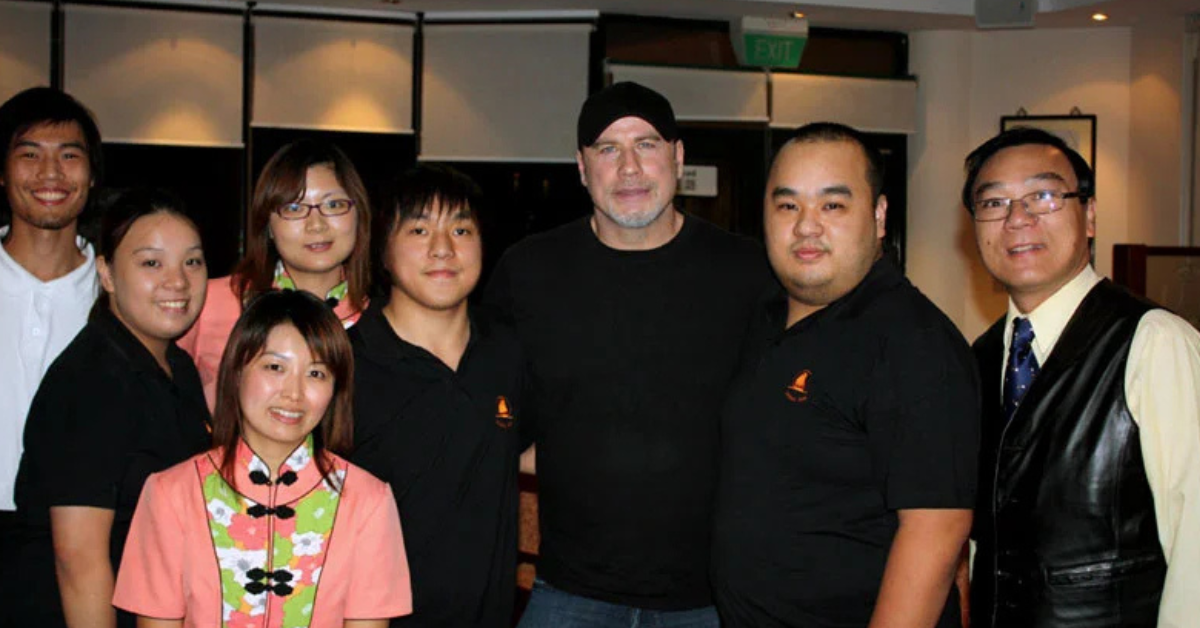
Highly regarded Cantonese restaurant China Sea, known for consistent quality seafood and an unexpected link to a famous Australian meme, operates from its elegant Park Road premises in Milton.
Under the guidance of respected restaurateur Stanley Cheung, China Sea specialises in fine Cantonese cuisine. Sources describe the food as consistently excellent, with seafood being central.
Diners praise dishes like whole steamed fish with ginger and shallots, lobster noodles, salt and pepper calamari, fresh chili mud crab, and large steamed NZ oysters. The restaurant prides itself on freshness, with dishes arriving steaming hot, perfectly presented, and tasting as if sourced directly from the ocean that morning.
Beyond seafood, other dishes receive high marks in customer reviews. Peking duck, often served two ways, is noted as a standout, alongside crispy skin roast pork, described as consistently excellent.
Photo Credit: Google Map
Photo Credit: Google Map
Photo Credit: Google Map
Honey chicken with thin, crunchy batter, deep-fried squid, sweet and sour pork, and Xiao Long Bao (soup dumplings) are also popular choices mentioned in reviews. Even desserts, like panna cotta, have been called perfect by diners. While widely considered authentic Cantonese, some feedback suggests the flavours might be slightly adapted for Australian tastes. Preparation takes place in an open kitchen staffed by qualified chefs.
China Sea is situated on the ground floor of the Cosmo Hotel and Apartments building at 60 Park Road, Milton, offering diners beautiful river views. This location is conveniently only a short drive from the Brisbane CBD and the Queensland Transit Centre. The restaurant’s interior provides an old-school but elegant setting, featuring carpeted dining areas, lazy Susan tables, and padded booths, making it feel suitable for special occasions. Outdoor seating is also available.
Despite the elegant feel, the dependable quality makes it a favourite for regular visits. Reports mention seamless service, with the owner often present, overseeing the dining room to ensure everything runs smoothly. The venue also caters to functions and parties for groups ranging from 20 to 50 people.
Before establishing the restaurant in Milton, Stanley Cheung ran a successful eatery in Brisbane’s Chinatown (Fortitude Valley) for approximately 25 years. The restaurant relocated to the elite Park Road dining precinct, bringing its established reputation along.
The original Chinatown location gained unexpected notoriety in 1991 following the dramatic arrest of Jack Karlson while he was dining there. His bewildered protests during the arrest, including phrases like “What is the charge? Eating a meal? A succulent Chinese meal?” and “This is democracy manifest!”, were captured on camera and have since become iconic Australian memes. The restaurant reportedly acknowledges this quirky part of its past life in Chinatown.